Designing an optimized layout for a commercial LPG station is not merely a regulatory checkbox. Poor spatial planning directly impacts operational uptime, limits throughput capacity, and compromises overall site safety. We often see operators treat storage, transfer, and dispensing as isolated components, which quickly leads to mechanical bottlenecks. This guide provides a transparent, engineering-focused breakdown of how to structure an LPG site—from bulk storage down to the dispensing nozzle. You can use these insights to evaluate equipment configurations and vendor proposals objectively.
We acknowledge pre-engineered modular setups significantly accelerate project timelines. However, local regulatory compliance, strict footprint constraints, and peak-hour flow demands ultimately dictate your final engineering design. By understanding the core synergy between mechanical systems and site layout, you ensure safer, more efficient daily operations.
Key Takeaways
Safety perimeters dictate site viability: Separation distances between storage, transfer points, and property lines determine whether a traditional or modular layout is feasible.
Component synergy prevents bottlenecks: Mismatched transfer pumps and dispensers lead to cavitation, slow fill times, and premature equipment wear.
Modular designs reduce CapEx risk: Pre-engineered skid systems condense deployment timelines but require rigorous vendor vetting for international safety certifications (e.g., FM Global, ATEX).
Measurement dictates profitability: Upgrading to advanced mass flow metering in dispensers mitigates vapor return losses and ensures billing accuracy.
Spatial Planning and Hazardous Zone Demarcation
A well-engineered LPG station begins with meticulous spatial planning. Planners must respect rigorous separation parameters to protect adjacent properties and secure site viability.
Defining Safety Distances
Industry-standard frameworks, such as NFPA 58 or equivalent local directives, mandate specific separation distances. These guidelines govern the space between storage vessels, property boundaries, buildings, and potential ignition sources. You must calculate these radii accurately during the initial site survey. Failure to secure adequate setback distances routinely forces costly redesigns or limits your maximum allowable storage volume. Authorities will reject layouts where vapor dispersal zones overlap with public right-of-ways.
Traffic and Workflow Modeling
Vehicle dynamics dictate operational efficiency during peak hours. You must design ingress and egress routes to prevent queuing bottlenecks. Passenger vehicles and bulk delivery trucks require distinct turning radii and traffic flows. If a bulk delivery truck blocks consumer access during a drop-off, the station loses immediate revenue. Planners should utilize swept-path analysis software to map out these trajectories. Ensure delivery vehicles maintain unobstructed access to the transfer bulkhead while keeping consumer traffic flowing smoothly toward the dispensing islands.
Hazardous Area Classification
Safety engineering relies heavily on Hazardous Area Classifications. These designations determine the required explosion-proof ratings for all electrical and mechanical components.
Zone 0: Areas where an explosive gas atmosphere is present continuously. You typically find this inside the storage vessel itself.
Zone 1: Areas where an explosive atmosphere is likely to occur in normal operations. Examples include the immediate vicinity of fill valves and dispensing nozzles.
Zone 2: Areas where an explosive mixture is not likely to occur, but if it does, it persists for only a short period. This includes the broader perimeter around transfer pumps and metering systems.
Common Mistake: Installing standard commercial electrical fixtures in Zone 2 areas. Always verify equipment carries the appropriate ATEX, IECEx, or UL explosion-proof certifications for its specific zone.
LPG Tank Configuration and Storage Site Integration
Storage dictates the heartbeat of your facility. Selecting the appropriate vessel type and sizing it correctly ensures you never run dry during high-demand cycles.
Capacity Sizing vs. Delivery Frequency
You determine optimal storage volume by balancing daily throughput projections against bulk supply logistics. A high-volume station situated far from a main supply terminal requires larger reserve capacities to buffer against delivery delays. Conversely, an urban station enjoying daily bulk deliveries might prioritize a smaller footprint. Calculate your peak daily dispensing volume, multiply it by your maximum expected delivery lead time in days, and add a 20% safety margin. This formula prevents vapor lock issues caused by critically low fluid levels.
Above-Ground vs. Mounded Storage
Operators must choose between above-ground and mounded (or underground) storage configurations. Each presents distinct engineering challenges.
Table 1: Storage Configuration Comparison
| Configuration | Primary Advantages | Key Challenges |
| Above-Ground | Easier visual inspection; significantly lower civil works and installation complexity. | Requires larger safety setback distances; highly exposed to ambient temperature swings. |
| Mounded / Underground | Drastically reduced safety distances; enhanced security; excellent thermal stability. | High initial excavation and civil engineering demands; requires advanced cathodic protection against rust. |
Selecting the Right LPG Tank
Commercial resilience relies on rigorous manufacturing standards. When sourcing an LPG tank, confirm it meets ASME Boiler and Pressure Vessel Code Section VIII (or regional equivalents like EN 13445). Mandatory safety fittings include hydrostatic relief valves, internal excess flow valves, and magnetic level gauges. These components ensure the vessel can safely vent pressure during extreme thermal expansion while providing operators with highly accurate liquid level readings.
The Transfer System: Pumps, Piping, and Flow Dynamics
The transfer system acts as the circulatory system of your station. Poor fluid dynamics here will cripple even the best dispensing equipment.
Pump Selection and Cavitation Prevention
Maintaining a liquid state under pressure is the primary goal of the transfer phase. You generally choose between regenerative turbine pumps and sliding vane pumps. Regenerative turbine pumps excel in high-differential-pressure applications, while sliding vane pumps handle varying flow rates with excellent self-priming capabilities.
Cavitation occurs when localized pressure drops below the vapor pressure of the LPG, causing vapor bubbles to form and implode. This violently erodes pump internals and halts liquid flow. To prevent this, engineers must guarantee adequate Net Positive Suction Head (NPSH) by placing the pump as close to the storage vessel as physically possible and sizing the suction line generously.
Pipe Routing and Material Standards
LPG flows demand seamless carbon steel piping (such as Schedule 40 or 80) and forged steel fittings. Threaded connections are prone to micro-leaks; we strongly advise welded joints wherever feasible. Layout engineers must minimize elbows and sharp bends to reduce friction loss in the suction lines. Additionally, any pipe section capable of trapping liquid between two closed valves requires a thermal expansion relief valve. Ambient heat easily causes trapped liquid to expand, rupturing lines if safety valves are absent.
Vapor Return and Pressure Management
Fluid transfer is not a one-way street. When the pump pushes liquid to the dispensing islands, bypass valves play a critical role. If the dispensing nozzles close, the bypass valve immediately redirects the pressurized liquid back into the storage tank. This vapor return architecture stabilizes the entire system. It prevents extreme over-pressurization during the transfer sequence, protecting pump seals and ensuring smooth restarts when the next customer arrives.
Dispensing Technology: Accuracy and End-User Safety
The forecourt is where engineering meets the consumer. Dispensing technology must balance rapid flow rates, unassailable safety protocols, and absolute measurement precision.
Metering Mechanisms
Dispenser accuracy directly impacts your margins. Operators primarily choose between volumetric positive displacement meters and Coriolis mass flow meters. Upgrading to a modern LPG gas dispenser equipped with Coriolis technology offers superior accuracy. Because LPG density fluctuates wildly with ambient temperature changes, volumetric meters often require complex temperature compensation algorithms. Mass flow meters measure the actual mass of the fluid directly. They possess no moving parts, resulting in long-term calibration stability and virtually eliminating vapor return losses.
Chart 1: Metering Technology Summary
| Feature | Volumetric Meters | Coriolis Mass Flow Meters |
| Measurement Base | Volume (requires temp compensation) | Direct Mass (temperature independent) |
| Moving Parts | Yes (susceptible to wear) | No (vibrating tubes) |
| Calibration Drift | Moderate over time | Extremely low |
Safety Interlocks and Hose Architecture
Consumer-facing equipment requires robust fail-safes. Mandatory safety features include inline breakaway couplings on the hoses. If a driver accidentally pulls away with the nozzle still attached to their vehicle, the coupling shears cleanly, instantly sealing both ends to prevent a catastrophic gas release. Dead-man switches (requiring continuous operator input) and shear valves at the dispenser base offer secondary layers of protection against impact accidents.
Integration with Forecourt Management Systems (FMS)
Modern dispensers act as digital nodes. They must integrate seamlessly with your Point of Sale (POS) and Forecourt Management Systems. This connectivity enables automated data reconciliation, shifting station management from manual logging to real-time oversight. FMS integration allows operators to perform remote diagnostics, track shift-by-shift dispensing data, and trigger automatic loss prevention alerts if meter readings diverge from tank depletion levels.
Traditional Builds vs. Modular Designs: Evaluating the LPG Skid
Deciding between a stick-built station and a modular design is a major strategic crossroad. Each approach serves different business models and deployment timelines.
The Modular Advantage
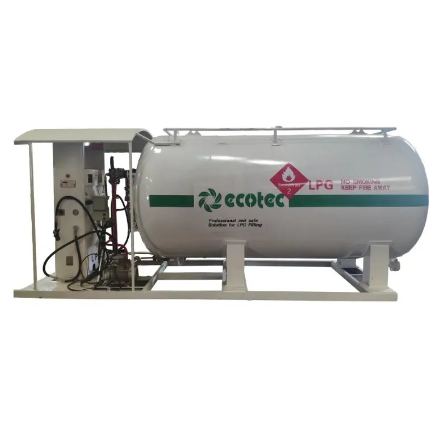
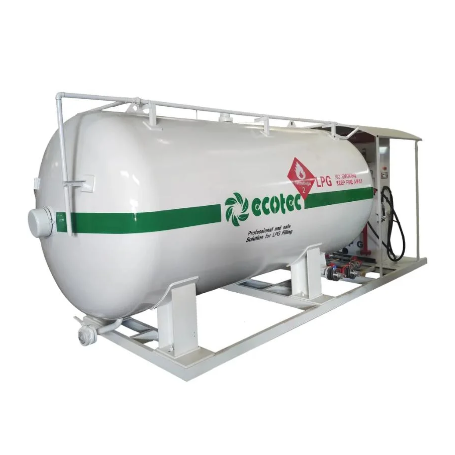
A pre-assembled, factory-tested LPG skid dramatically simplifies site construction. Because engineers mount the tank, pump, bypass valves, and dispenser onto a single steel chassis, on-site civil works are drastically reduced. You eliminate the need for complex trenching and specialized pipe welding at the location. This plug-and-play methodology consistently accelerates regulatory approval timelines, as the skid unit typically arrives with consolidated safety certifications from the factory.
Scalability and Relocation
Skid-mounted systems offer immense commercial flexibility. If you are testing a pilot location in a new geographic market, a modular unit limits your sunken infrastructure risks. Operators expanding corporate fleets often deploy skid stations to regional depots. Should route logistics change, you can unbolt the skid, load it onto a flatbed, and relocate the asset to follow demand.
Limitations to Consider
Despite their agility, modular skids are not universally appropriate. Consider a traditional layout if your project meets any of the following conditions:
Ultra-High Volume Demands: Highway service centers requiring multiple dispensing islands operating simultaneously typically exceed the pump capacity of a standard modular skid.
Severe Space Restrictions: Mounded tanks paired with remote dispensers often fit better into tight, oddly shaped urban plots than fixed rectangular skids.
Custom Architectural Requirements: Sites requiring underground piping to maintain a specific aesthetic or canopy design necessitate traditional engineering.
Compliance, Safety Standards, and Vendor Shortlisting
Procuring equipment is straightforward; ensuring that equipment complies with local laws and international safety standards requires diligence.
Navigating Certification Frameworks
Stakeholders must demand equipment backed by recognized safety authorities. Look for certifications from FM Approvals, CE (for ATEX compliance in Europe), or UL. Relying on a manufacturer’s self-certified claims introduces massive liability risks. Regulatory bodies will halt construction if critical components lack traceable, third-party laboratory testing credentials. Ensure your procurement contracts specify exactly which international standards every valve, pump, and sensor must meet.
Evaluating Vendor Capability
Your relationship with an equipment partner extends far beyond the delivery date. Use stringent criteria for shortlisting vendors. Prioritize manufacturers who offer transparent Factory Acceptance Testing (FAT). You want to review their pressure test logs before the equipment ships. Furthermore, assess their post-installation support. A vendor offering high-quality hardware is useless if they lack a localized maintenance network capable of dispatching technicians during an emergency shutdown.
Next-Step Actions
To move your layout project from concept to execution, follow this structured path:
Initiate a Comprehensive Site Survey: Map out exact property lines, traffic flows, and topography. Identify adjacent properties to calculate firm NFPA 58 separation distances.
Engage a Certified Engineering Firm: Hire specialists in hazardous fluid dynamics. Let them translate your commercial throughput goals into exact pipe diameters and pump specifications.
Request Highly Specified RFQs: Do not ask vendors for generic quotes. Provide them with your engineering firm's specific schematics. Demand itemized Request for Quotations outlining the exact make, model, and certification standard of every component.
Conclusion
Building a high-performing LPG site requires cohesive engineering across storage, transfer, and dispensing. Treating these zones as isolated silos guarantees flow restrictions and maintenance headaches down the line. We strongly advise decision-makers to prioritize long-term compliance, component interoperability, and accurate mass flow metering over initial low-cost equipment sourcing.
Whether you choose the rapid deployment of a skid unit or the tailored capacity of a traditional mounded build, the principles of fluid dynamics and safety zoning remain absolute. Take action today by consulting with certified layout engineers. Request customized schematics to ensure your site operates safely, efficiently, and profitably from the very first fill.
FAQ
Q: What is the minimum safe distance between an LPG tank and the dispenser?
A: The required distance varies heavily by local regulations and tank capacity. Under NFPA 58 guidelines, a common benchmark is maintaining at least 10 to 20 feet (3 to 6 meters) of separation between the dispensing unit and the storage vessel. Always consult your local fire marshal for specific jurisdictional requirements.
Q: How do I prevent vapor lock in my station's transfer pumps?
A: Vapor lock happens when liquid LPG turns into gas inside the suction line. Prevent this by placing the pump as close to the tank as possible to maximize Net Positive Suction Head (NPSH). Ensure the suction piping is generously sized, limit the use of elbows, and maintain proper bypass valve functionality.
Q: Can an LPG skid be customized for different environmental temperatures?
A: Yes. Manufacturers can customize skids for extreme climates. For high-temperature environments, they install sun shields, specialized thermal relief valves, and higher-pressure-rated tanks. For freezing climates, systems may include insulated piping, specialized elastomers for seals, and vaporizers to maintain adequate operating pressure.
Q: What is the typical ROI timeline when upgrading to mass flow LPG dispensers?
A: While Coriolis mass flow meters carry a higher initial CapEx, operators typically see a Return on Investment within 12 to 24 months. This rapid ROI stems from the elimination of vapor return losses, zero calibration drift over time, and highly accurate direct mass billing during temperature fluctuations.
Q: What localized approvals are generally required before beginning site construction?
A: You typically need an environmental impact assessment, zoning board approval for hazardous materials, and a fire safety permit from the local fire marshal. Additionally, you must submit detailed engineering drawings proving compliance with regional setback distances and electrical explosion-proof classifications.


